
Payment Gateway
 Rain Tan • October 11, 2021
 Last updated: October 2021

Running an e-commerce business in Singapore? Too many e-commerce payment gateway options and you don’t know which one to choose?
We’ve narrowed down the 10 best e-commercepayment gateway options in Singapore and provided some insights to each.
As more consumers shift their reliance on making purchases via e-commerce, it is crucial for the site owners to ensure that there is a smooth shopping experience in place.
(Read more: Ecommerce Customer Experience: All you need to know(2021) )
One of the most important aspects of setting up an e-commerce site is opting for the most suitable online payment gateway for your target country and audience.
What is an e-commerce payment gateway?
An e-commerce payment gateway is an application service provider that authenticates and authorises payment between your customers and your e-commerce site. It uses a front-end technology to send customer information to the merchant acquiring bank where the transaction will then be processed.
E-commerce payment gateways allow automatic processing of credit cards, debit cards or other forms of payment – this is important if you want money.
Before you can choose the best e-commerce payment gateway for your business, let’s first understand the pros and cons of each payment gateway and identify if it suits well for your business. Here is our Singapore payment gateway comparison.
Top 10 list of payment gateways for Singapore:
1. PayPal
Paypal is globalised and is one of the most well-trusted payment platforms with over 224 million users across the globe.
It has long been the leader in providing fast and secure transactions and has been successful in reaching many business enterprises till today.
Paypal’s key features:
- Accepts payments: via debit and credit cards i.e. Mastercard, Visa, American Express etc. and alternatives such as Paypal Credit, iDeal (Europe) and Mercado Pago (Latin America).
- Makes payments: supports supply chain by managing cashflow, making prompt payments and simplifying payouts.
- Manages risk: protects transactions through 24/7 fraud monitoring, seller protection for PayPal payments and a built-in support of two-factor authentication provided by cards (3D Secure).
- Streamlines operations: provides reporting and analytics of sales performance, and dispute resolutions.
PayPal also offers transaction fees at 3.9% + SGD$0.50 (domestic sales) and 4.4% + Fixed Fee* (international sales). It is also available in over 200 countries/regions and supports up to 25 currencies.
Since PayPal adds a sense of credibility and safety to any e-commerce site; both new and mature, this option should be well embraced by startups in Singapore.
As an added advantage, it can instantly assure consumers that their personal information is protected from vulnerabilities such as security breaches.
For both local and international consumer base, Paypal is a great option for any business for its ‘3s’ – “speed”, “security” and “simplicity”.
The main drawback of Paypal as a payment solution is that it is not one of the cheapest payment gateways for Singapore (due to its high transaction fees).
2. Stripe
Millions of businesses of all sizes use Stripe’s software to manage their businesses online. It is known to be one of the fastest growing payment platforms globally as well.
Stripe consists of a developer-friendly setup which simplifies customising your checkout to support your customer buying experience. It has a broad focus on mobile e-commerce, SaaS, non-profits and platform-based options.
Key features of Stripe:
- Accepts payments: via all major debit and credit cards i.e. Visa, Mastercard, Maestro, American Express and mobile payments i.e. iOS and Android SDK.
- Processes payments: supports recurring payments and instant payouts
- Settle and Reconcile: simplifies and accelerates reconciliation of transactions through financial reporting.
- Manages payments: analyses data to provide insights into charges across different payment types.
Unlike Paypal, Stripe also has more payment options available including Apple Pay and Android Pay. It also offers a deeper feature-set with its powerful developer tools. This allows for the most easiest data import from Stripe into different types of software that makes it more favorable at times than Paypal.
Stripe also offers a flat transaction fee at 3.4% + SGD $0.50 (credit and debit cards), 2.2% + SGD$0.35 (digital wallets such as Alipay and WeChat Pay) and 3.3% (GrabPay, Apple Pay and Google Pay). As these rates are relatively lower than Paypal, it has also become a great alternative for startup businesses who require more features as well.
It is also well-known to be used on popular platforms such as Shopify due to its seamless integration with the platform.
- Omise

Omise, a Thailand startup, made its way to Singapore in 2016, offering multi-currency payment, of up to 5 different currencies.
Omise’s key features:
- Accepts payments via debit and credit cards i.e. Visa, Mastercard, JCB and American Express, and mobile payment, PayNow.
- Support plugins that is easily integrated with Magento, Shopify, WooCommerce, etc
- Automation: set up recurring payment from your customers
Other than that, Omise also offers a transaction fee of 3.3% + SGD$0.30 for credit and debit cards, and 1% for PayNow.
However, Omise is offering a cheaper transaction fee if you choose us as your vendor. Click here to find out more.
3. DBS PayLah!
DBS PayLah! is more than just Singapore’s current favourite application. It is a personal mobile wallet which allows for the performance of transactions at ease.
Consumers are able to use PayLah! by debiting their money directly from their DBS accounts. As it is one of the most popularly used payment applications by all ages in Singapore, it is a great payment gateway option for e-commerce site owners to tap upon as well.
The DBS Credit Card Acceptance & Paylah! Online Checkout for e-commerce businesses facilitates seamless payment and simplifies the reconciliation processes.
DBS PayLah key features:
- Comprehensive: omni-payment acceptance channels and services
- Ease of integration: comprehensive support for implementing DBS PayLah! and Payment Gateways API
- Exclusivity: consumers can transact via DBS PayLah! and enjoy faster processing with PayLah! Express Checkout
DBS PayLah! offers a transaction fee of 3.00% (credit and debit cards) and 2% to 4% (for instalment plans). There is also a one-time setup fee of S$800 (subject to GST) and an annual fee of S$1,000 (subject to GST).
This will also be an ideal online payment gateway for any ecommerce business in Singapore to easily boost their sales, secure transactions and increase their credibility.
4. HitPay
HitPay is an emerging payment gateway option in Singapore. For small businesses who are selling online, or multi-channel, HitPay is one of the most utilised options.
Overview of Key Features:
- Accept payments via PayNow, credit and debit cards, WeChat and Alipay.
- Supports e-commerce content management systems (CMS) such as Shopify, WooCommerce, Magento and Wix.
- Recurring billing/subscription functions.
HitPay also offers different fees for different markets and payment methods. Examples of their transaction fees include 0.8% + SGD$0.30 (PayNow), 2.9% + SGD$0.60 (domestic card payments), 3.65% + SGD$0.50 (international card payments) and 2.7% + SGD$0.35 (WeChat & AliPay).
With such wide payment fees and methods, Hitpay is a very flexible option for sellers who are aware of the payment preferences of their target market.
- Atome

Atome was launched in December 2019, is one of the newer payment gateways introduced in Singapore. Their main selling point “3 easy payments. 0% interest.” allows users to split their purchase into three interest-free instalments. Currently partnering over 2,000 leading online and offline retailers across various industries.
Their concept of “Buy it. Own it. Pay later.” are all done in their mobile app. This makes it easy for consumers to have everything at the tip of their fingers.
They accept all major cards and they are easily integrated with major e-commerce platforms such as WooCommerce, Shopify, Magneto, Prestashop and etc.
5. Hoolah
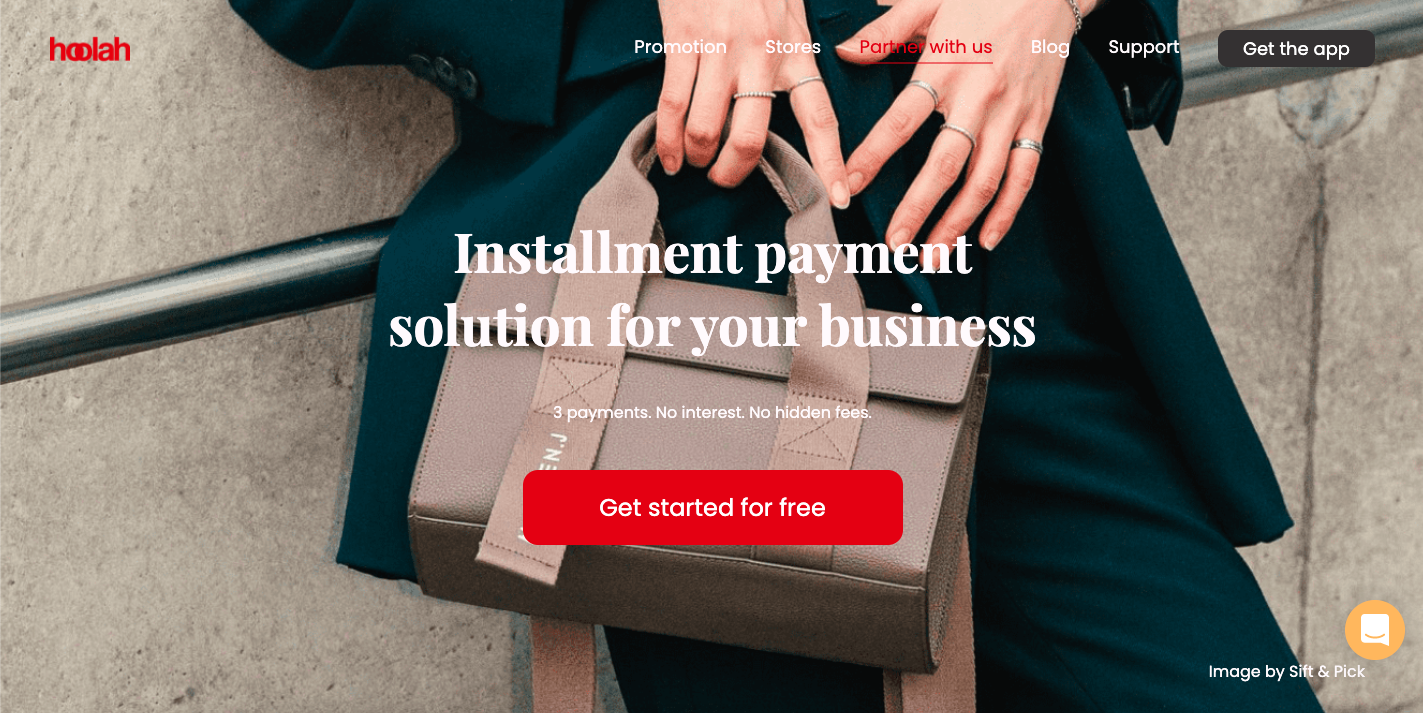
Hoolah is a homegrown startup, so if supporting local excites you, it’s definitely worth looking into. Their “buy now, pay later” option is a big selling point, on top of “No sign-up fee, no processing fee, no admin fees, mark-ups or hidden charges”.
Hoolah is a payment gateway that provides a “buy now, pay later” option. This is where only ⅓ of the payment is to be made upfront and the cost of purchase will be divided into three interest-free instalments.
Also known as an instalment payment solution for many, this payment gateway option largely helps businesses reduce friction during consumer purchase decisions. It is best used by e-commerce sites which sell high-priced items and who may want to offer an instalment option for their consumers.
Hoolah also integrates with CMS such as Shopify, WooCommerce and Magento. In addition to aiding online consumers, it is also fairly popular by many offline merchants in Singapore.
7. eWay Singapore
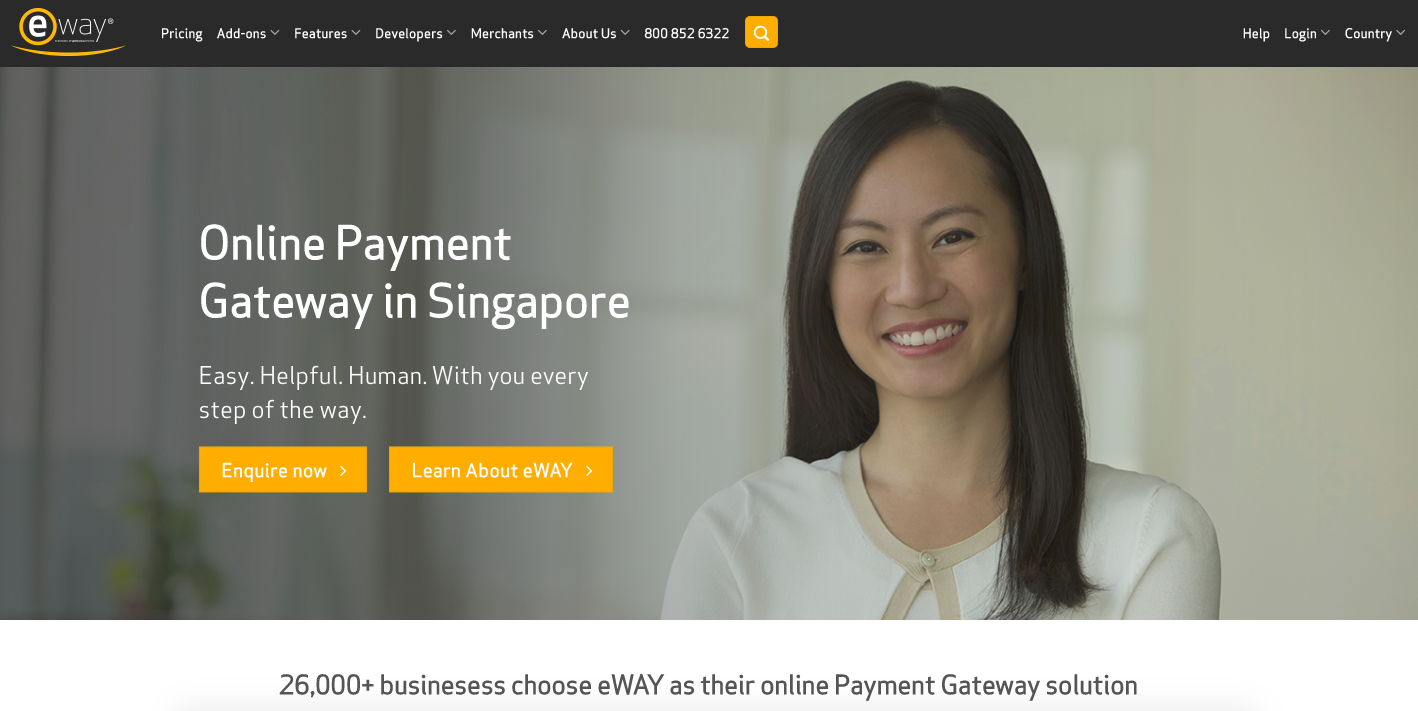
eWay is another payment gateway option that Singapore businesses can consider.
eWay key features:
- More human and flexible: strong partners and developers, simple to set up, easy to manage and quick to scale with changes.
- More connected: consists of fast payment processing and tools to securely link business to bank accounts.
- More protected: consists of fortified Internet security and PCI compliance with built-in anti-fraud tools.
eWay also offers a transaction fee of 3.4% + SGD$0.40 with no setup fee. It also integrates well with platforms such as Woocommerce, Magento, Opencart, VirtueMart, and Prestashop.
Even though eWay is known for its scalable payment solution and customer support, only merchants with bank accounts in certain countries can use eWay to receive payments. This includes countries such as Australia, New Zealand, Singapore, Hong Kong, Malaysia and the UK.
Another drawback is that eWay’s built-in fraud detection tool has to be manually activated from a merchant’s bank account. This hence creates more hassle and is not as convenient compared to other payment gateway options.
9. Adyen
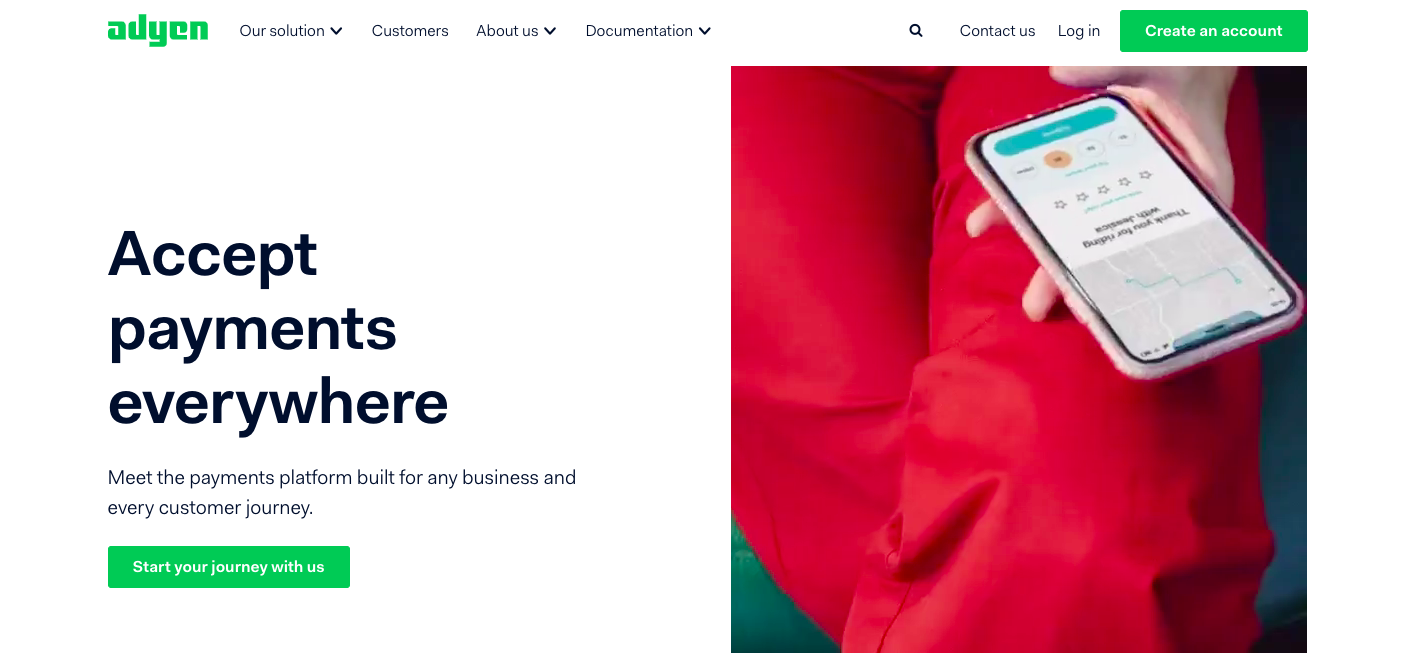
Another payment gateway for Singapore is Adyen.
Adyen is a global multichannel payment company offering businesses an outsourced payment solution which enables merchants to accept and provide payments globally.
Adyen key features:
- Payment methods: offers multiple payment methods globally
- Risk management: Use a data-driven approach to block fraud with a unique risk management engine.
- Revenue optimisation: use data and machine learning to optimise payment for more revenues
- Customer insights: provides data-rich insights from all channels and locations
Adyen is supposedly targeted at fast growing companies, thus it is an ideal option for entrepreneurs and startups. With its wealth of marketplace tools for users, it is known to be an easy system to do international business in any volume.
The drawback of this payment gateway option is that it may not be suitable for merchants who are considered “high-risk”. It may also be pricey for merchants who do a low volume of monthly business.
- WeChat Pay

Finally, the payment gateway you should take note is WeChat Pay.
WeChat Pay originates from China supports up to 26 currencies, allowing users to pay through the app without having to exchange currency. It is the primary payment mode by Chinese consumers around the world with over 800 million monthly active users, providing a smart and efficient payment solution for both consumers and merchants.
Their main payment mode is using QR code. Each merchant have their own fixed payment collection code, once user scan the QR code, the amount is automatically entered and the payment is completed.
WeChat Pay can be integrated with CMS such as WooCommerce.
Understanding Merchant Accounts and Payment Gateways; Why Do You Need Both?
Merchant accounts and Payment Gateways serve two very different purposes. There is often a misconception that only one of them is necessary and hence we will address why there is a need for both.
A payment gateway facilitates online transactions and allows you to process them. It is a link that makes the connection between a customer’s bank account and your merchant account, allowing funds to be transferred after a transaction is cleared.
On the other hand, a merchant account is a holding account where those payments land before being deposited into the bank account. Simply put, it is a place where information about payment transactions are collected.
For businesses that accept card payments, a merchant account is a place where funds are held and after payment verifications, the funds are transferred to the bank accounts.
Therefore, necessary to ensure that both the merchant accounts and payment gateway are incorporated into your e-commerce site. Since there is a need for both, they are also known to come bundled together as a service for many merchants today.
Conclusion
Choosing a suitable payment gateway option is essential for e-commerce site owners as it is one of the most important steps in every consumer shopping journey.
You need to know which payment method your targeted audience prefers, and which payment gateway can be integrated into your ecommerce website. Knowing the best transaction fee structure will help you avoid excess costs.
If you still need help to decide on a payment gateway, simply talk to our digital strategists. Web Imp is a PSG Pre-approved vendor for Ecommerce, so we can build your ecommerce website with 80% grant support, and help to integrate the right payment gateway for your needs.


 Wilson • May 11, 2020
  Brenda Tan • April 8, 2020